Addiction Solitaire: play free online
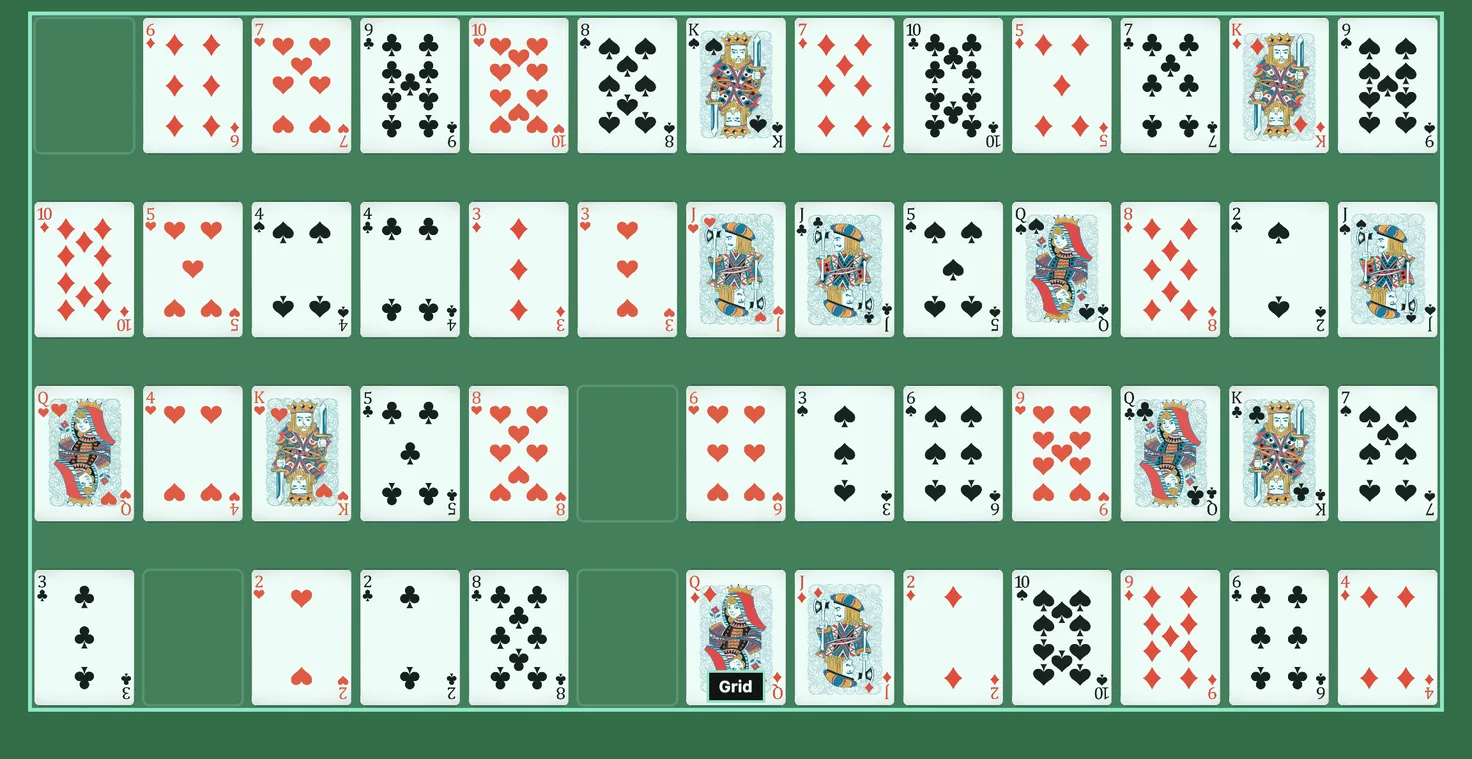
Addiction Solitaire — the same game as Gaps, Montana and Spaces — has no columns and no piles. All 52 cards go down face-up in a grid of four rows of thirteen, and then the four Aces are lifted straight back out. They never return. What they leave behind is four gaps, and those gaps are the only thing you ever move a card into.
Almost every gap wants one card and one card only: the next rank up from the card immediately to its left, in that same suit. Fill it and the cell the card came from becomes the new gap. There are always four, and they travel around the grid with you.
That is the whole mechanism, which is why the game is so quick to learn and so easy to lose. A run of obvious moves ends, and you are looking at four gaps that each want a card sitting behind a King.
The Addiction Solitaire layout
- Grid: a 4 × 13 board — four rows of thirteen cells, holding 48 face-up cards and four gaps.
- Gaps: four, wherever the Aces happened to fall. They can be anywhere, including side by side.
- Reshuffles: three, on the Reshuffle button below the board, labeled with the number you have left.
- There is nothing else on the table: no stock, no waste, nowhere to park a card.
How to win at Addiction Solitaire
Each row has to read as one suit in order from left to right — 2, 3, 4 and on up to the King — with the empty cell sitting at the far end. That is 48 cards placed. The Aces stay out of the game entirely.
How to play Addiction Solitaire: the rules
- A gap at the start of a row takes any 2. It is the only moment in the game where you get a choice of cards rather than a single answer.
- Every other gap names one exact card. Look at the cell on its left: if that is the four of hearts, the gap takes the five of hearts and nothing else.
- A gap to the right of a King is dead. No run continues past a King, so nothing can ever go there. Move that King somewhere useful and the gap comes back to life.
- A gap with another gap on its left asks for nothing. It only becomes worth anything once the gap to its left has been filled.
- Cards come from anywhere in the grid. Where a card currently sits is irrelevant — if it is the card a gap wants, it can go.
- Drag your 2s rather than tapping them. A tap sends a card to the first gap that will accept it, scanning from the top left. For any other card that is the only legal gap anyway, but every empty row start accepts every 2, so a tapped 2 may land in a row you did not want.
- Three reshuffles. Each one keeps the same-suit run that starts at the 2 at the left edge of each row, opens a fresh gap immediately after the part it kept, and redeals every remaining card. A row with nothing worth keeping gets its gap at the start.
Addiction Solitaire tips and strategy
- A reshuffle only protects the left edge. A run of six cards from the 2 survives intact. Six cards in perfect order in the middle of a row are swept up and dealt out again like everything else. Working from the left is not a preference, it is the only way to keep anything.
- A 2 in the wrong row is expensive. There are four 2s and four rows, and once a 2 opens a row the only way to undo the choice is to move it to another empty row start — assuming one is open.
- A King can switch a gap off. To switch it back on you have to move the King, and that needs a gap whose left-hand neighbor is the Queen of the King's suit. Until one appears, that King is not going anywhere.
- Reshuffle only when the board is genuinely dead. You get three in a game, and each one costs you all the work sitting in the middle of your rows. Check for one more legal move first.
- A dead gap is not always a problem. The finished board is four rows of 2-to-King with a gap sitting behind each King, so the last four gaps you are left with are dead ones by design. It is a King stranded mid-row that costs you the deal.
- The order you fill gaps in decides the deal. Undo winds back as far as you like, so a row that stalled halfway is often worth replaying in a different order.
Crescent is the other game here with nothing to draw and three reshuffles to spend, though its cards sit in piles where only the top one shows. FreeCell has no reshuffle at all: everything you need is on the table, and the deal is won by thinking.