Forty Thieves Solitaire: play free online
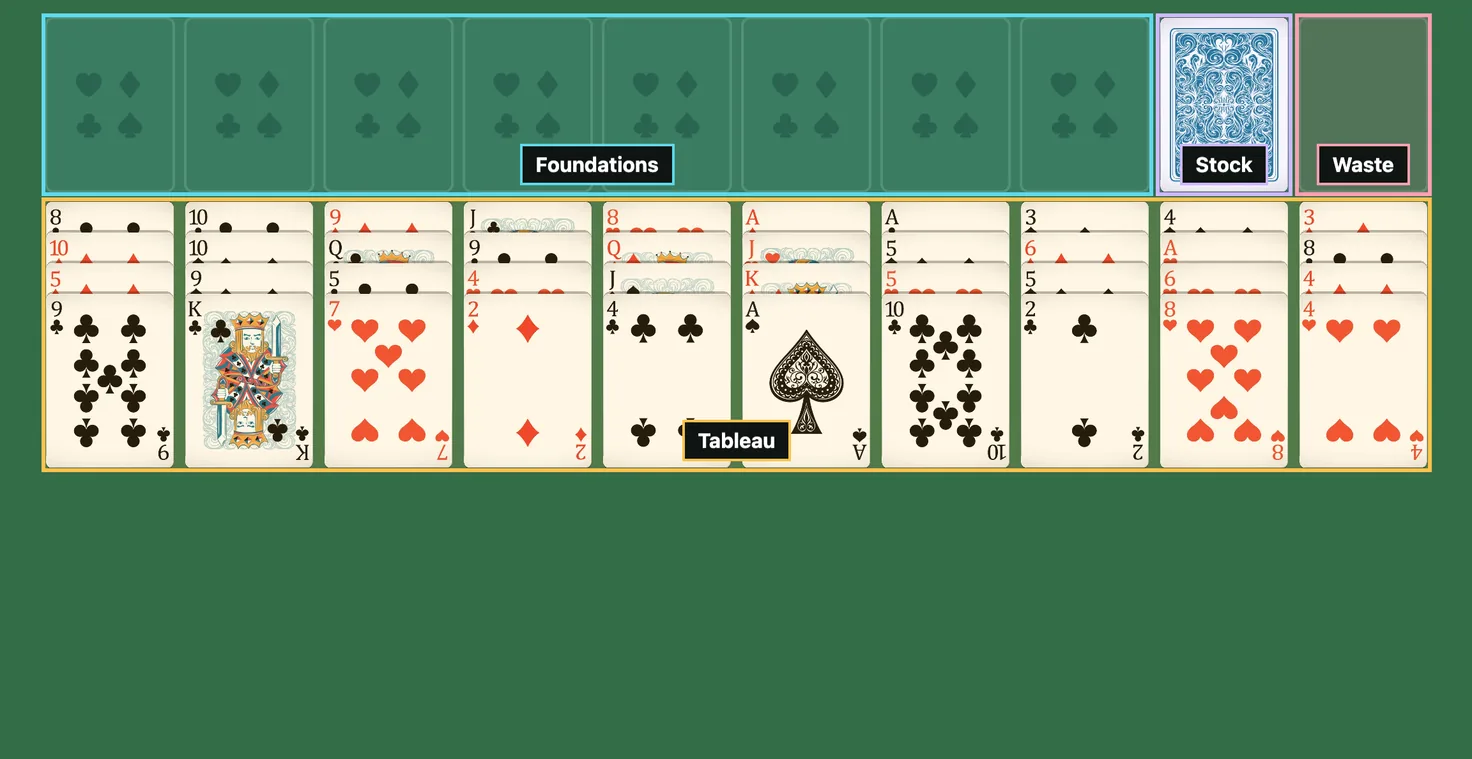
Forty Thieves — also known as Napoleon at St Helena, or Big Forty — uses two full decks and hides almost nothing. Forty cards sit face-up in ten columns of four — the thieves of the name — so everything you have to sort is in front of you from the first move. The only secret on the table is the order of the stock.
The other two names are historical. Napoleon at St Helena ties the game to the island he was exiled to; Big Forty is the older English name for the same deal.
Two rules make it hard. In the tableau cards move one at a time, never as a group, and they only land on a card of the same suit. And the stock is dealt once, with no redeal: a card you cannot place goes to the waste and waits there until something on the table can take it.
That makes it a slower game than Klondike, and a more deliberate one: a deal that dies usually dies because of a move made forty cards earlier.
How Forty Thieves Solitaire is dealt
All 104 cards are on the table from the start:
- Tableau: ten columns of four face-up cards, forty in all.
- Foundations: eight empty slots along the top.
- Stock: the other 64 cards, face-down, turned one at a time.
- Waste: where turned cards pile up. Only the top one is in play.
How to win at Forty Thieves Solitaire
Build eight piles of thirteen cards. Each pile holds a single suit and runs from the Ace up to the King, so every suit fills two of them and all 104 cards finish on the foundations.
Forty Thieves Solitaire rules
- Only the top card of a column moves. Four cards already in the order you want still travel one at a time, and each one needs a place of its own.
- Tableau builds run down within one suit. The six of diamonds goes on the seven of diamonds. The six of hearts does not, however red it is.
- An empty column accepts any card — from another column or from the top of the waste. It is the only pile in the game with no conditions attached.
- The eight foundation slots all start the same. Put an Ace in one and it belongs to that suit from then on, climbing to the King a card at a time.
- Cards on the foundations are not gone for good. If the four of spades would help on the five of spades, take it back down.
- The stock turns one card, and there is no second pass. Once the 64 are out you have the tableau and the top of the waste; play that card and the one under it appears.
- Tapping a card auto-plays it. The game takes the destination it rates highest, which is not always the one you had in mind. When you know where a card belongs, drag it there.
Tips and strategy for Forty Thieves
- Every card on the table has a twin. Two decks make that unavoidable. If the five of spades you need is buried under the other five of spades, the lower one stays put until the upper one moves — worth spotting early.
- Those 64 stock cards never come round again. Each card you turn covers the one before it. Play out every useful move on the table before you draw another.
- An empty column is worth holding on to. It is the only place any card at all can go, and with two decks you want one constantly. Filling it with the first card that fits is usually a waste of it.
- A long column is not a problem by itself. With a high card on top it absorbs cards for you: a King takes the Queen, then the Jack, then the ten, one at a time. Emptying it just to own a space tends to leave the board worse than it was.
- Send Aces and 2s up the moment you see them. They support almost nothing in the tableau, and each Ace claims one of the eight slots. Be slower with the middle ranks: a 9 on a foundation holds nothing until you pull it back.
- Two foundations per suit means two speeds. Once both Aces of a suit are up you can feed one slot and hold the other back, so the cards you might still want in the tableau are not all locked away at once.
- Try things — none of it is final. One card turned at the wrong moment can decide the deal, and Undo goes back as far as you like. When nothing surfaces, the Hint button will point at something.
Spider 2 Suits deals 104 cards into the same ten columns, but only in two suits, and there a finished sequence travels as one piece with five extra rows to break a jam. Crescent also fills eight foundations from two decks, except it hands you a card in each of them before you start.