Klondike Solitaire Turn 3: play free online
Solitaire turn 3 is Klondike with exactly one change: the stock turns over three cards at a time instead of one, and only the top card of the three can be played. That single rule is the whole difference in difficulty.
Two cards out of every three sit in plain view and out of reach. You can read them, plan around them, and do nothing with them until the card on top has somewhere to go. The 3 card draw turns the stock from a source of cards into a queue to unpick.
There is a second consequence that catches people out: the triples are fixed. Run the stock empty, recycle it, and the same cards come back up on top of the same groups of three — the order never changes on its own. Playing one card off the waste is the only thing that shifts the grouping on later passes.
How to play Solitaire Turn 3: the deal
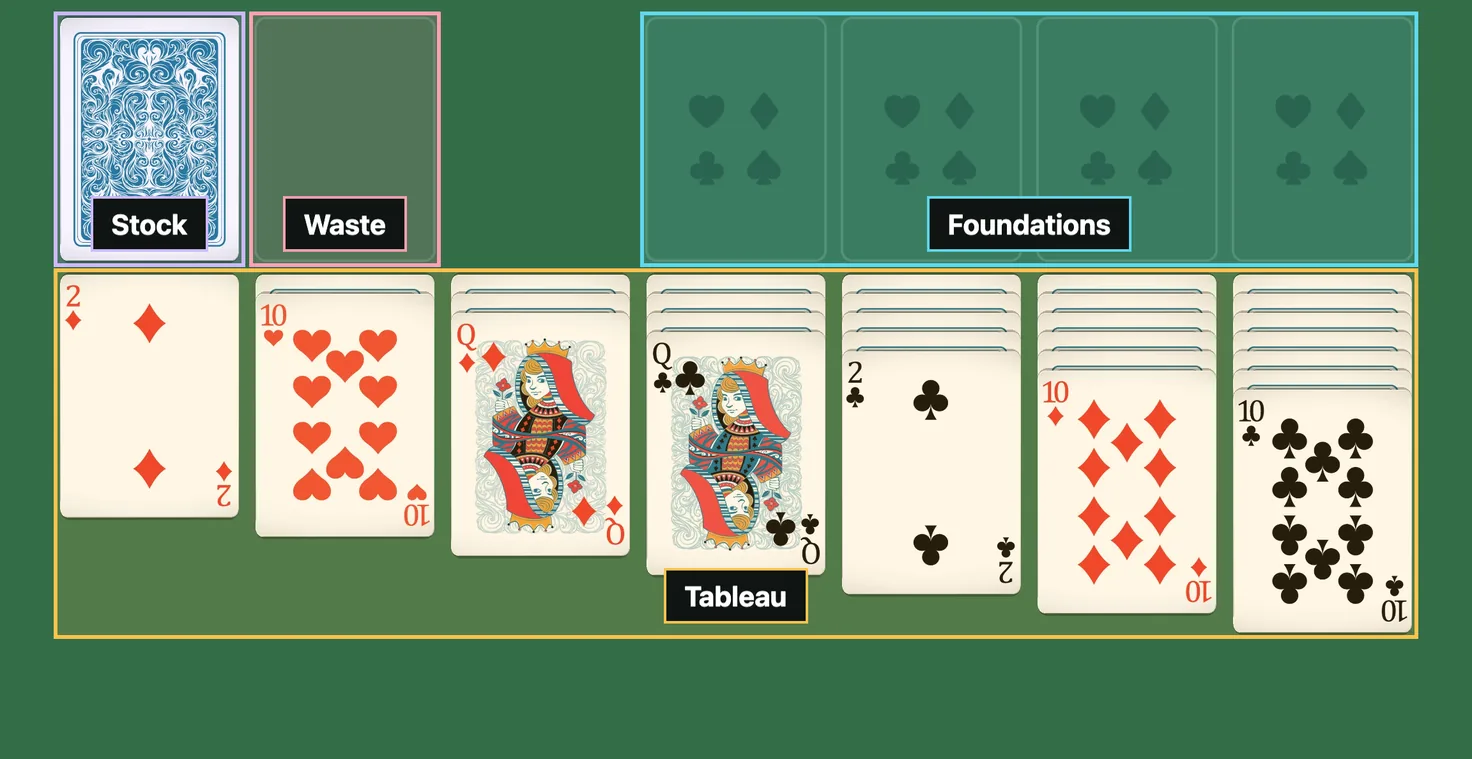
- Tableau: seven columns of one, two, three and so on up to seven cards, 28 in all. Each column shows one card, the last dealt to it; the other 21 stay hidden.
- Stock: the remaining 24 cards, face down. Each click turns three of them.
- Waste: the drawn cards, fanned face up. Only the top of the fan is live; the two beneath are visible but locked.
- Foundations: four empty piles at the top. No suit belongs to a pile until its first ace arrives.
How to win at Solitaire Turn 3
The finish line is the one every Klondike shares: four full foundations, each running ace to king in a single suit. Only the route differs — the deck reaches you three at a time and lets you play one of them.
Solitaire turn 3 rules
- Each draw turns three cards, and only the top one plays. The other two stay under it, face up. A short stock turns whatever is left. People also call it 3 card solitaire, or draw-3; it is the same 52 cards as turn 1.
- Play the top card and the one below it takes its place. To reach a card buried two deep, you have to find homes for both cards covering it; that is where the game is won and lost.
- The stock recycles without limit, and without a shuffle. When it is empty, click it again: the waste turns over and becomes the stock. The cards run past you in the same order, in the same threes.
- Taking one card off the waste re-cuts the triples on the next pass. Play any waste card, useful or not, and the groups of three re-form one position over. It is the only lever you have over what surfaces later.
- A column runs down in alternating colors. A 6♥️ goes on a 7♠️ or a 7♣️ and nowhere else, one rank per step.
- An ordered run travels as a single block. 8♥️, 7♠️, 6♥️ moves onto any black 9 in one go. A group that is not itself a proper run is refused.
- Empty columns take a king and nothing else, bare or with the run already stacked on it. Kings cost more here: one lying second or third in the fan is untouchable until the cards above it move.
- Foundations climb by suit from the ace, one card per move, and a card can be called back down if a column needs it. Face-down cards flip by themselves as soon as the card covering them leaves.
Solitaire turn 3 tips and strategy
- Read all three cards, not just the top one. Turn 1 shows the deck one card at a time; here you get two cards of warning, so you can clear a spot before the card arrives.
- Count the draws. Twenty-four cards is eight clicks to a full pass, so knowing a card is three draws away decides whether you spend a move now or save it.
- Spend a waste card to change the alignment. When a pass shows you nothing useful, playing any legal waste card re-cuts the triples for the next pass. Undo makes testing both versions free, and Hint surfaces a move you missed.
- Pick the shuffle, not just the game. New Game can deal you an Easy, Medium or Hard board instead of a random one, graded on how deeply the low cards sit. That choice counts for more at three cards a draw.
- Table moves first, then the stock. Only tableau moves turn over face-down cards. But do not stop when the visible moves run out: the stock comes round again, unchanged.
- Do not empty a column on a hunch. An empty column with no king for it is a hole you paid to dig. Wait until a king is on the table or on top of the waste.
- Keep the four foundations roughly level. Every card you send up is one fewer landing spot for the opposite color, and mobility is the scarce resource here.
- Dead ends arrive earlier here. When no reachable card can be played, the board tells you and offers a new deal. With two cards in three locked away, that comes with the variant.
If the three-card queue is not the challenge you want, Las Vegas solitaire draws one card at a time but allows just one pass through the deck, and FreeCell removes the guessing altogether: all 52 cards are face up from the start and there is no stock at all. Canfield keeps the draw-3 stock but changes the target: its foundations start on whatever rank the deal turns up, not on the ace.