Las Vegas Solitaire: play free online
Las Vegas solitaire is Klondike with the stock cut down to a single pass. In ordinary Klondike, when the cards run out you turn the waste over and go round again, as often as you like. Here you do not. The 24 stock cards come out one at a time, once, and then they are done.
Everything else on the table will look familiar: seven columns, four foundations to build by suit, one card per draw rather than three as in Klondike turn 3. What changes is the weight of each draw. A card you pass over comes back only once you have cleared every card that landed on top of it.
Las Vegas scoring is what gives the variant its name and its shape. The dollars are scorekeeping, not stakes — nothing is played for here.
How to play Las Vegas Solitaire: the deal
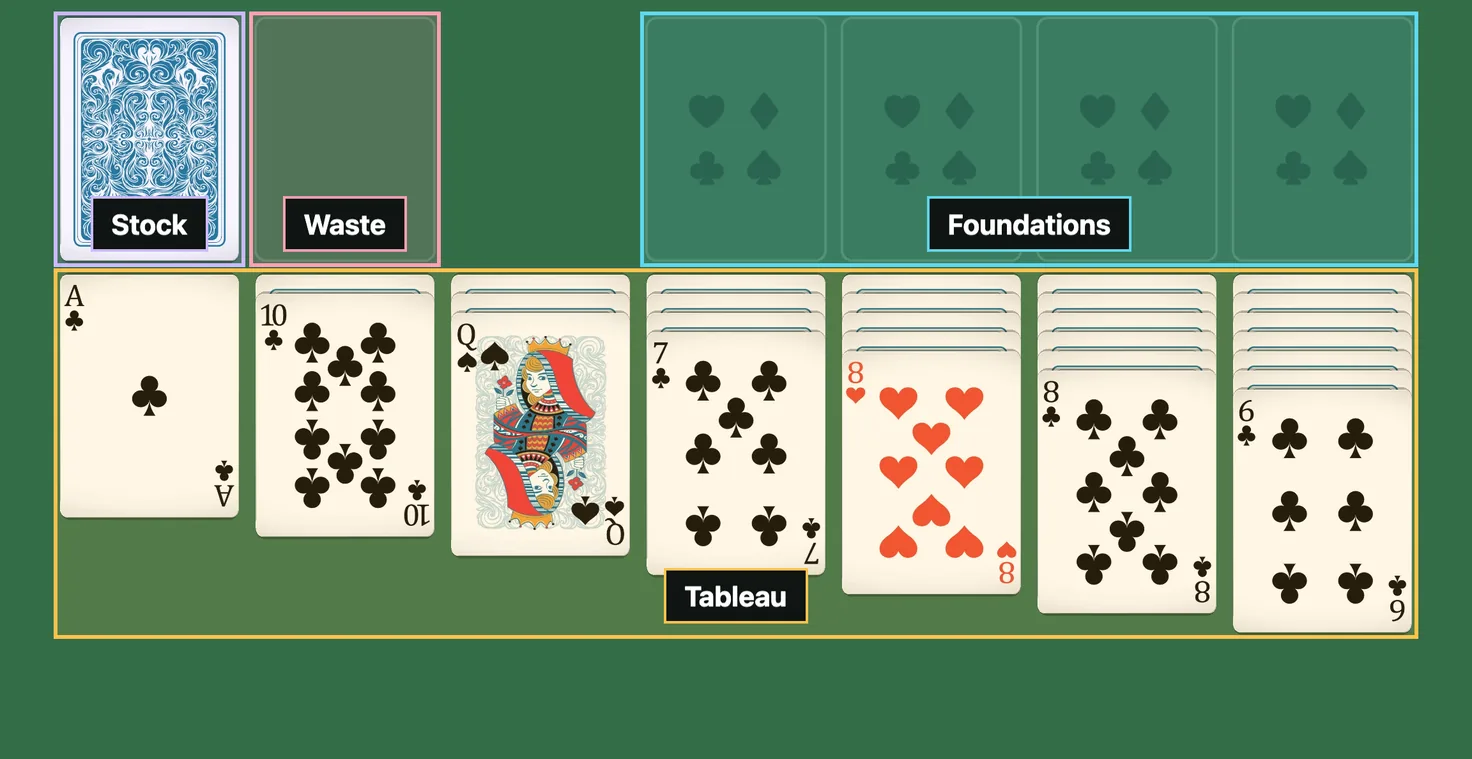
- Tableau: seven columns, 28 cards in all. One card in the first column, two in the second, up to seven in the last. Just one card per column is turned up, the one at the end of it; the other 21 stay face down.
- Stock: the 24 undealt cards, face down. One card per click, and no second pass.
- Waste: the turned cards, face up. Only the top of the pile can be played.
- Foundations: four empty piles. None is reserved for a suit at the start — the first ace to arrive settles what that pile collects.
How to win at Las Vegas Solitaire
Move the whole deck up to the foundations, ace through king, a suit to each pile. The target is the same as classic solitaire, but you get one trip through the stock to reach it, so most deals end with a partial board rather than a win.
Las Vegas solitaire scoring: -$52 and $5 a card
A deal opens at -$52, a dollar for every card in the deck, and each card you land on a foundation is worth $5. No whole number of cards lands exactly on zero: ten leaves you $2 down, eleven puts you $3 up, and clearing all 52 finishes at +$208. A card taken back off a foundation hands back its $5 — often still worth doing, since a 4♠️ returned to the tableau to carry a red 3 can do more than the five it costs. Nothing on the table keeps a running total, so your result is whatever is on the foundations when you stop, counted at five dollars a card.
Las Vegas solitaire rules
- One pass through the stock, with no reload. Cards turn one at a time. Once the stock is empty, clicking it does nothing at all — the waste never goes back.
- After the stock is empty, the waste unwinds from the top only. You can keep working down through it as long as each card that surfaces has a legal home. The moment the top card has nowhere to go, everything under it is locked until a move in the columns opens a spot — and if none ever does, the rest stays buried.
- Down the columns, red and black alternate. A 4♦️ can only land on a black 5, so the 5♠️ or the 5♣️. Suits are irrelevant here; what has to change with every card is the color.
- Cards already in sequence move as one block. A column ending J♦️, 10♠️, 9♥️ moves onto a black queen in one go — and moving three cards for the price of one move is worth hunting for when the stock is finite.
- Only a king can take an empty column, alone or with the run stacked on it. Nothing else may start a column.
- A foundation takes one card at a time, in suit, starting with its ace. The card can come from a column or from the top of the waste.
- Face-down cards turn over on their own the instant the card covering them is moved away.
Las Vegas solitaire tips and strategy
- Wring out the tableau before each click. Good advice in any Klondike; here it is the whole discipline, because a click spends one of only 24 cards and nothing replaces it.
- The 21 face-down cards are the real obstacle, not the stock. Given two moves of similar value, take the one that turns a card over.
- Send aces and 2s up the moment you see them. They are never useful as support in a column, and each one is $5 already secured.
- Do not open a column without a king for it. A hole nobody can fill has cost you moves that do not come back.
- Leave a low card in place when it is carrying something. Clearing the tableau onto the foundations feels like progress, but a 5♦️ holding a black 4 is doing more work where it stands.
- Undo has no limit, and it un-spends draws. In a one-pass game that is the whole point: a click you regret is a click you can take back, foundation cards included.
- Running out of moves is normal here. With a single pass, plenty of deals cannot be finished however well you play. The board flags a dead position as soon as it reaches one, and a fresh deal is one click away.
For the same layout without the one-pass limit, play Klondike turn 1: the cards you skip all come back, in the same order, so the second lap is one you can plan for. If it is the single pass you came for, Golf solitaire is built on one — a single run through the stock, no recycle.