Double Pyramid Solitaire: nine rows, two decks, two redeals
Double Pyramid is Pyramid Solitaire dealt from two decks. The arithmetic is untouched — cards leave in pairs worth 13, a King leaves on its own, and only a card with nothing resting on it can be played. If you know the small game, you already know the rules.
What changes is scale. The triangle is nine rows deep instead of seven, 104 cards go into the deal instead of 52, and the stock can be sent round twice more after the first pass. Each of the three changes how the deal should be played, not just how long it takes.
How Double Pyramid is dealt
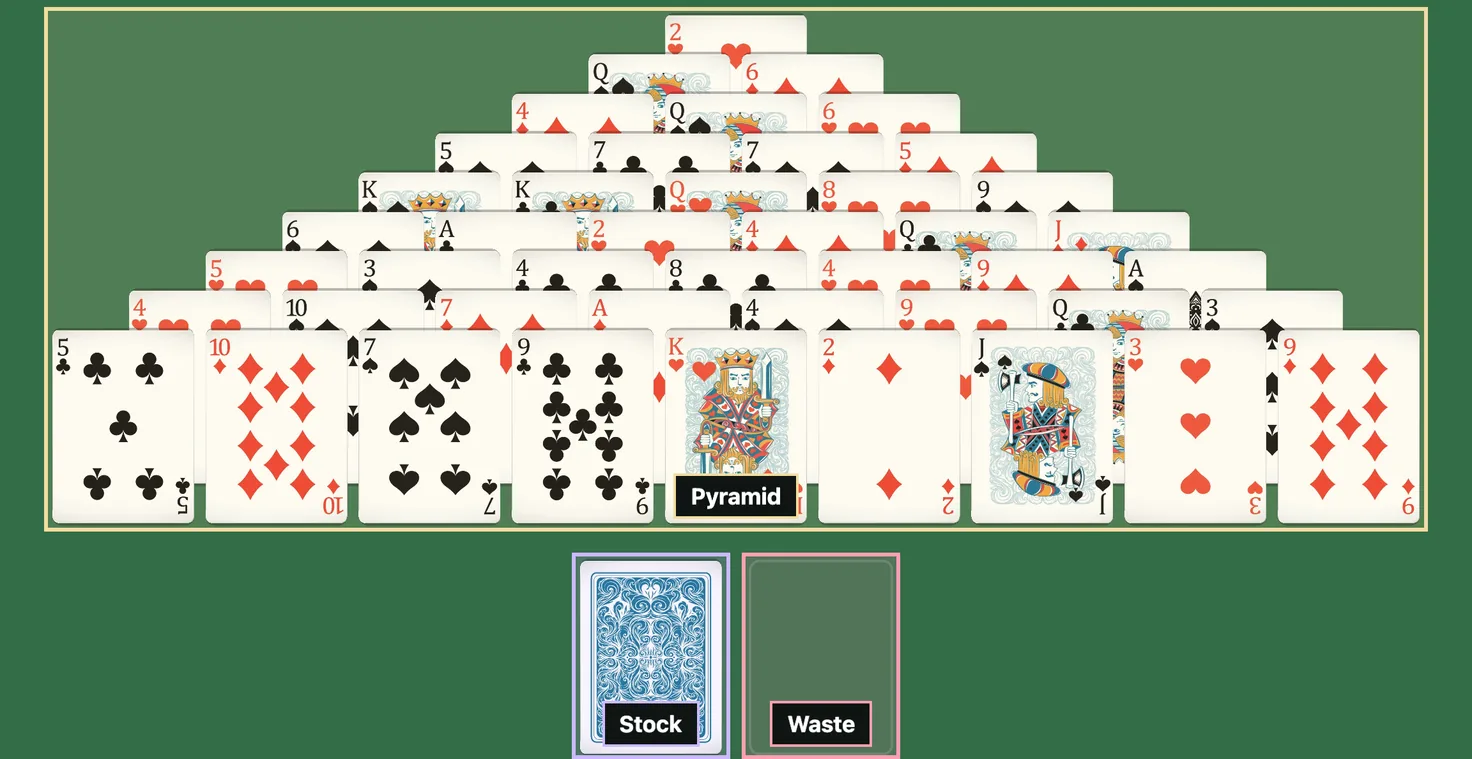
- Pyramid: 45 cards over nine rows, every one face up — one at the apex, then two, three, and so on to nine along the base. The rows are offset, so each card half-covers two cards in the row above, or a single one at either end of a row. That is 17 more cards than the single-deck triangle, and two more rows standing between the base and the top.
- Stock: the remaining 59 cards, face down, turned one at a time. Almost two and a half times the 24 of the one-deck game.
- Waste: empty at the deal, and still only the top card is in play.
Two decks also means eight cards of every rank, not four. Eight Kings, eight Aces, and a real chance of seeing the same card twice on the table at once.
How to win at Double Pyramid
Strip all 45 cards out of the pyramid. With 59 cards in the stock against 45 in the triangle, the waste will still be a thick pile when you win, and none of it counts. Clearing the triangle is the whole job.
How to play Double Pyramid
- Pairs total 13, Kings go alone. Ace counts 1, Jack 11, Queen 12, King 13, and the number cards count what they show. Drag one free card onto its partner; tap a free King to send it away by itself.
- Free still means both cards resting on it have gone. With nine rows, the nine base cards start free and every other card waits on two removals underneath it. Deeper rows mean the wait compounds: a card in the middle row needs 14 removals beneath it, and the card at the apex only moves once all 44 others are gone.
- One card of every pair comes from the pyramid. The partner may be the top of the waste, never a second waste card.
- Two redeals, three passes in all. When the stock runs out, its empty space shows a gold recycle glyph labeled REDEAL. Tap it and the unused waste turns face down again as the new stock. You may do that twice, which is two more looks than the single-deck game allows.
- A redeal does not shuffle. Cards come back in the order you already saw them, minus whatever you paired away. A pass in which you use nothing repeats itself card for card.
- You cannot be stuck before the third pass. While the stock holds cards you can always draw, and while a redeal remains you can always send the waste round again. A dead board is only possible once the third pass is under way.
Double Pyramid tips and strategy
- Skipping a card is cheap, until it is not. While redeals remain, letting a card go past costs you almost nothing. On the third pass there is no later, so play everything the board will accept.
- When a card is out of reach, look for its twin. Eight cards of each rank are in the deal, so before dismantling half the pyramid to reach one particular 8, check whether another 8 is sitting in a lower row where it frees far sooner.
- Eight Kings, eight plugs. No King pairs with anything. A King in the pyramid holds two cards up and releases none, so take each one the moment it is exposed — including any King you turn onto the waste, before the next draw covers it.
- Cut a channel upward instead of clearing a flank. Nine rows is a lot of triangle, and a card only frees when both neighbors below it are gone. Between two equal pairs, take the one that opens a path toward the apex rather than the one that tidies an edge.
- Treat the first pass as a survey. You will see all 59 stock cards before the first redeal. Noting which ranks came past — and roughly when — tells you on the second pass whether the partner you are waiting for is actually coming.
- Save the hard choices for the last pass. Since nothing can jam before the third pass, the first two are free to experiment in: the only cost of a bad order is the time it takes. Undo has no limit if you want to test a line and take it back.
If nine rows feel like too much table to manage, the classic Pyramid Solitaire is one deck, seven rows and a single pass through the stock — tighter, and less forgiving. For a different way of dismantling a card picture, TriPeaks clears three peaks with runs of consecutive ranks instead of sums.