Canfield Solitaire: play free online
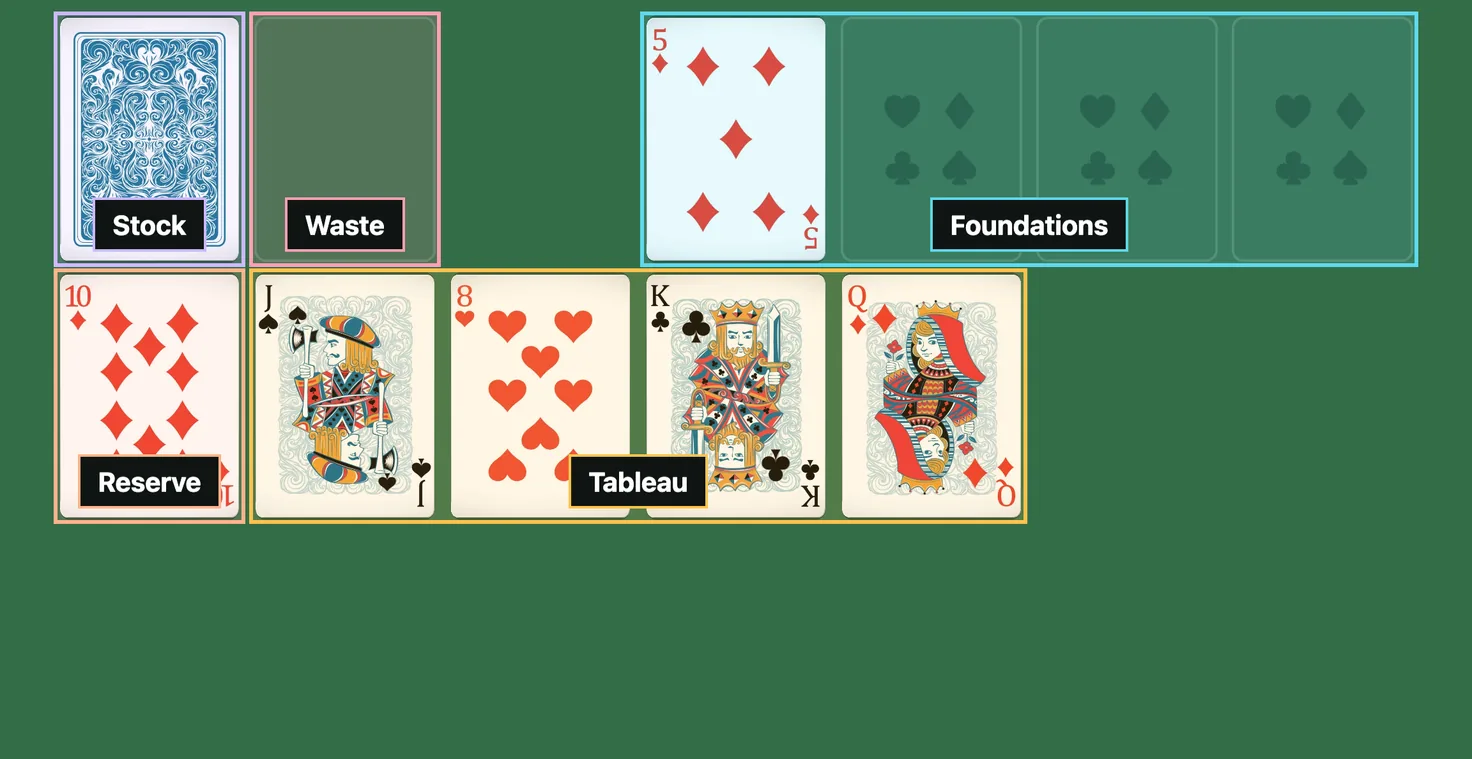
In Canfield Solitaire the four foundations all begin on the same rank, and that rank is not necessarily the Ace. One card is dealt onto the first foundation at the start, and its rank sets the opening for every pile: if it is a 5, each foundation runs 5, 6, 7, and after the King it turns the corner (K → A) and keeps climbing until it closes on the 4.
The second thing that sets Canfield apart is the reserve: thirteen cards in a stack, with only the top one showing. You can play that card whenever it suits you, but the reserve is not entirely yours to command. The moment a tableau column empties, the reserve fills it, whether you wanted it or not. Draining the reserve is the real work of the deal, and nothing closes until it is gone.
Setting up Canfield Solitaire
All 52 cards fall into five areas:
- Reserve: thirteen cards stacked. Only the top one is playable; the rest wait underneath it.
- Tableau: four columns, one face-up card each — as short as a column can start. They grow from what you put there and from what the reserve feeds in.
- Foundations: four of them. One is dealt a card at the start, and that card's rank becomes the opening rank for all four. Only that pile has a suit to begin with; the other three take theirs from the first card to land, one suit each.
- Stock: the 34 cards left over, turned three at a time, the same draw as Klondike Turn 3.
- Waste: empty at the start. It collects the turned cards, and only the most recent one can be used.
How to win at Canfield Solitaire
Complete all four foundations, thirteen cards each, one suit per pile. You do not necessarily start at the Ace: the opening rank is whatever card turned up at the deal, and each pile ends on the rank just below.
Canfield Solitaire rules
- Each foundation climbs one rank at a time in a single suit, and turns the corner where it has to: unless the deal opened on an Ace, the Ace follows the King. Cards arrive one by one, never as a group, and thirteen closes the pile.
- Tableau columns descend by one in alternating colors. On the 8 of hearts goes the 7 of spades or the 7 of clubs. The corner turns here too, so a black King may be placed on a red Ace.
- A run of cards moves as a unit. Pick up a card in a column and everything on top of it travels with it.
- The reserve refills an empty column by itself, immediately. While any card remains in the reserve, that space is not yours. It becomes a free column for a card or run you choose only once the reserve is exhausted.
- The stock turns three cards at a time, and only the last one turned is playable; the final draw of a pass may hold fewer than three. When the stock runs out it does not disappear: the empty pile picks up a gold REDEAL mark. Tap it and the waste goes straight back in, in the same order, as many times as you like.
- Foundations accept the reserve top, the waste top, or the top card of any column.
- What went up can come back down. A card can be pulled off a foundation and returned to a column when you need it to hold something else.
- A tap lets the game choose; a drag leaves the choice to you. Tap a card and it travels with everything covering it, to wherever the game judges best. Drag it and the destination is yours.
Canfield Solitaire tips and strategy
- The reserve comes before everything. All thirteen of its cards must leave before the deal can close, and every time the reserve fills a column, the card that lands there is not your choice. When two moves look equal, move from there.
- Check the reserve top before you empty a column. The space will not stay open: it takes that card, already in plain view. If you have no use for it there, you have spent a move making the table worse.
- Remember the corner. With the King and the Ace touching, an Ace in a column is not a dead end. An opposite-colored King goes on it, and the descent continues from the King.
- A draw-3 pass repeats the same groups. Run the stock through without playing anything and the same triples come out in the same order next time. Play a card out of the waste while the pass is still running, though, and every later group slides by one, floating up cards that were stranded in the middle. Taking the last card before you redeal changes nothing — the shift needs cards still in the stock.
- The starting rank changes what you are counting. If the deal opens on the 9, the Aces are no longer the cards to watch: the 9s and the 10s are. Read the first foundation and set priorities from there.
- Undo has no limit, and it pays to use it. A reserve card dropped into the wrong column is hard to dig back out. The Hint button suggests a move when the table looks stuck.
If you like the three-card draw but want a bigger table, Klondike Turn 3 gives you seven columns and foundations that always start at the Ace. If you would rather have the whole deck dealt out at once, with no stock to draw from at all, try Yukon Solitaire.