Pyramid Solitaire: play free online
Pyramid Solitaire is a one-deck game built on a single sum. Cards leave the table in pairs that add up to 13 — a 6 with a 7, a 5 with an 8, a Queen with an Ace. A King is already worth 13 and goes without a partner.
Every card in the triangle is face up from the first moment, so there is nothing to uncover and nothing to guess. The whole game is the order you take the pairs in. Here the stock is turned once and once only, and a card you pass over does not come back.
How Pyramid Solitaire is dealt
A standard 52-card deck fills three areas:
- Pyramid: 28 cards in a triangle of seven rows — one card at the apex, two below it, and so on down to seven along the base. From the second row down, each card straddles two cards in the row above and half-covers them — or a single one, at either edge of a row.
- Stock: the 24 cards left over, face down, turned one at a time.
- Waste: empty at the deal. Every card you turn lands here, and only the newest one is ever playable.
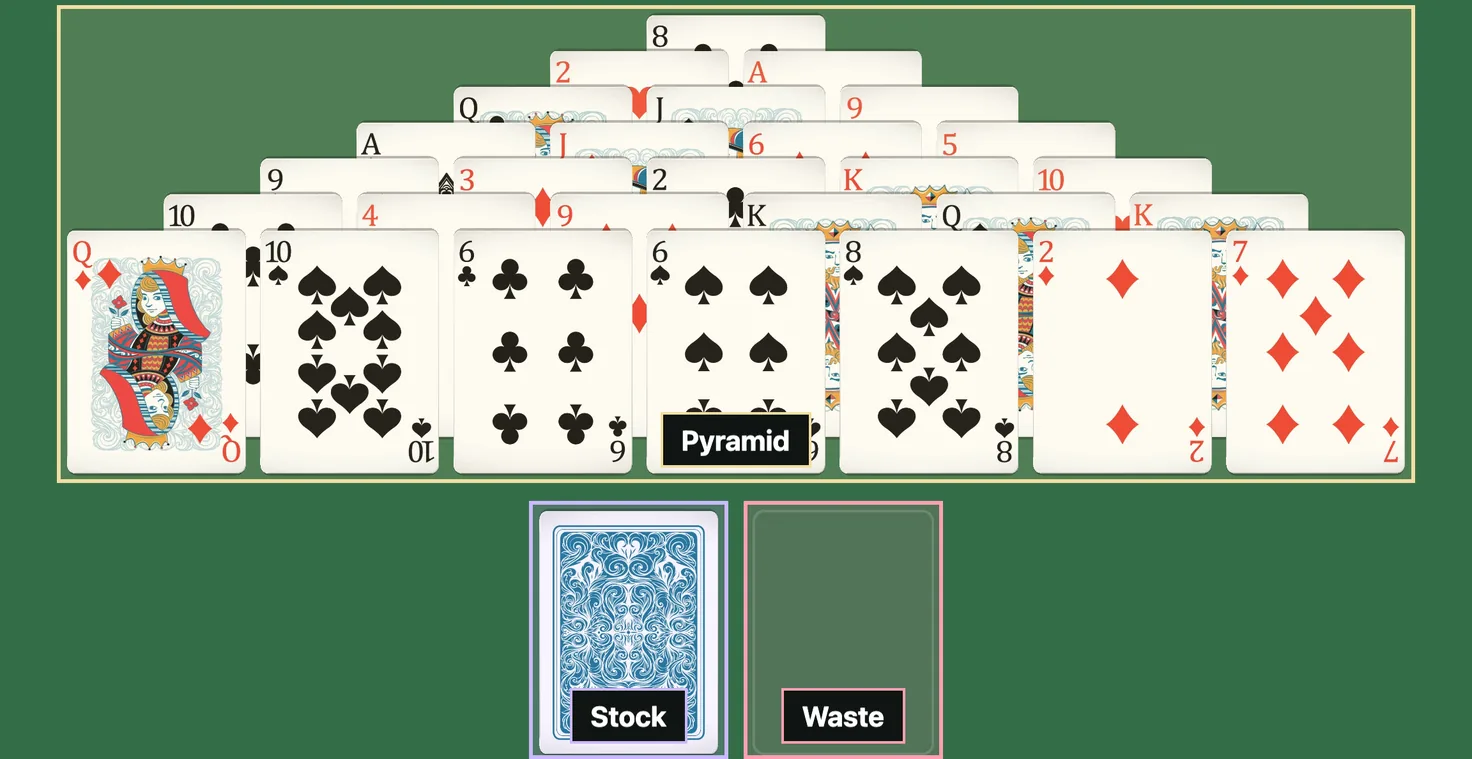
How to win at Pyramid Solitaire
Clear the pyramid — all 28 cards. Whatever is still sitting in the stock or the waste counts for nothing. The deal is won the instant the last pyramid card leaves the table.
Pyramid Solitaire rules
Card values are the whole arithmetic of the game:
A=1, 2=2, ... 10=10, J=11, Q=12, K=13
- A pair must total exactly 13. That leaves six pairings in the deck: A+Q, 2+J, 3+10, 4+9, 5+8 and 6+7. To take a pair, drag one free card onto the other.
- Kings leave alone. A King is 13 by itself, so it needs no partner — tap it, as long as it is free. The same is true of a King sitting on top of the waste.
- Tapping is for Kings and for the stock. Tapping two cards one after the other does not pair them. Pairs are made by dragging.
- Only free cards can be played. A pyramid card is free once both cards resting on it — the two in the row immediately below — have gone. The seven cards along the base are covered by nothing and are free from the first move.
- At least one card in a pair comes from the pyramid. The other may be the top of the waste. Two cards outside the pyramid never pair with each other.
- The stock turns one card at a time. The card you turn stays on top of the waste until you use it or turn the next one. Pair away the top card and the one beneath it is back in play.
- One pass, no redeal. When the 24 stock cards have been turned, the stock stays empty and stays a bare outline — no redeal button appears, because this version has none. Anything you skipped is out of the game for good.
- The board says when the deal is dead. If no pair, no King and no draw is left, a "No moves available" banner comes up with Undo and New Game on it. Until it does, something is still playable.
Pyramid Solitaire tips and strategy
- Look for pairs inside the pyramid before you look at the waste. A pyramid-to-pyramid pair takes two cards off the triangle; a pyramid-to-waste pair takes one. Given a choice, take the first.
- Remove Kings the moment they come free. A King pairs with nothing, so while it sits there it holds up two cards and repays you with none. The same goes for a King turned from the stock: leave it and the next draw buries it.
- Work across the full width, not down one side. Stripping the right-hand side clean while the left stands untouched leaves the upper rows just as stuck, because a card only frees when both of its coverers are gone.
- Check every free card before you turn the next one. The card you just drew is on top only until the following draw, and on a single pass there is no second look at it.
- Count the partners you still need. Two free Queens and no Ace in the triangle means both Aces have to arrive from the stock, and that should change which pair you take first.
- A jam is not always your fault. With one pass through the stock, some deals do not come out however you play them. Undo has no limit, so you can climb all the way back to the first move and try a different order — and dealing again is a fair choice too.
If you want more room to work in, Double Pyramid builds nine rows out of two decks and lets you turn the stock three times over. If what you enjoy is taking a shape apart card by card, TriPeaks does it with three peaks and a chain of ranks instead of a sum.