TriPeaks Solitaire: play free online
TriPeaks Solitaire — also written Tri Peaks or Three Peaks — is named for the three peaks of cards standing in front of you. It is played as a chain. One card always sits face up on the waste, and from the peaks you may take any free card ranked one above or one below it. That card then becomes the reference itself, and the chain carries on from there.
Suit never matters — only rank. That makes it a quick game — one you read at a glance instead of calculating. When a chain runs, five or six cards can come off one after another without touching the stock, and occasionally a great many more.
How TriPeaks Solitaire is dealt
One 52-card deck fills the table:
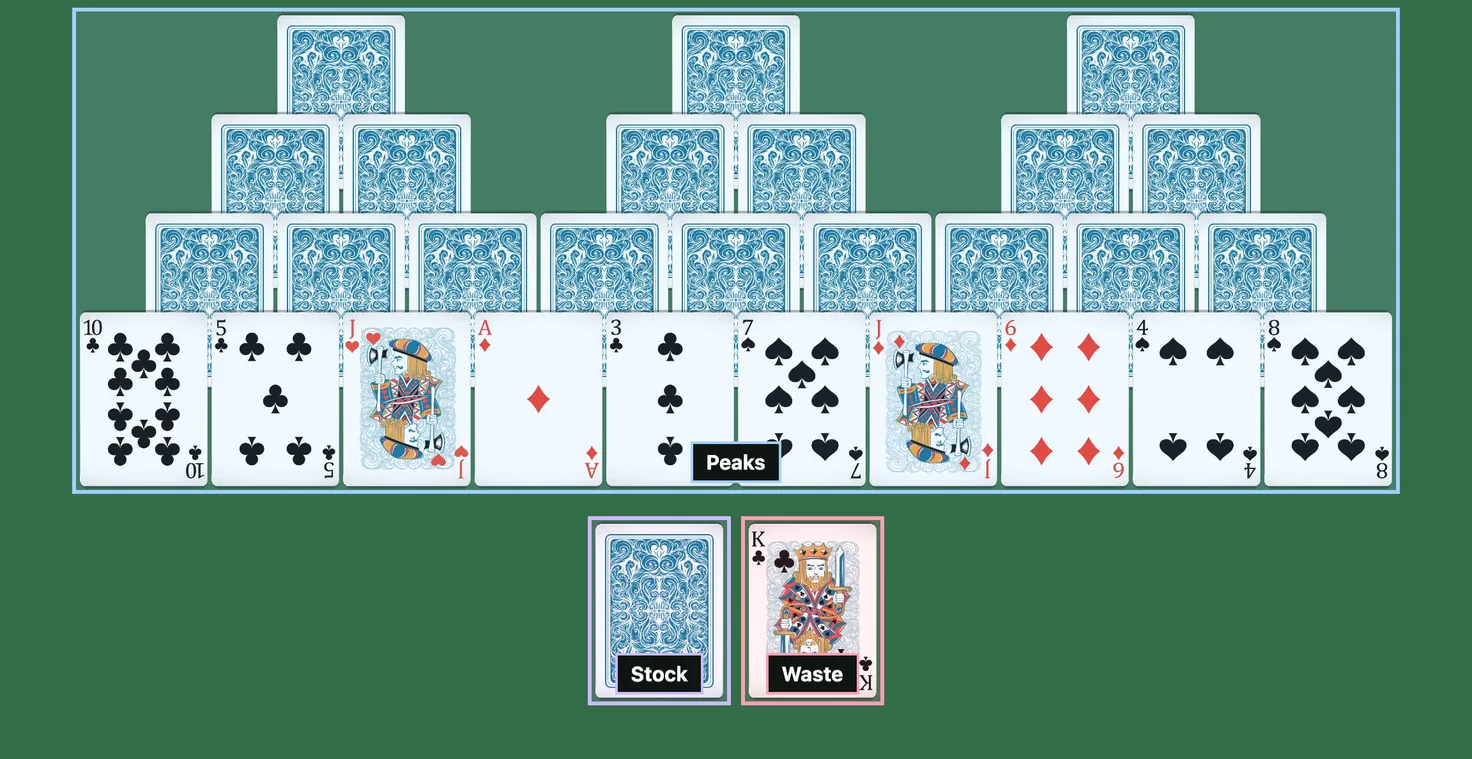
- Peaks: 28 cards. Each peak has one card at the top, two beneath it, then three. Below them runs a single row of ten that serves as the base of all three peaks at once. Only those ten are face up — the other 18 are face down.
- Stock: 23 cards face down, turned over one by one, whenever you choose.
- Waste: starts with one card already turned. That card is your first reference.
How to win at TriPeaks Solitaire
Clear the 28 cards of the three peaks. Cards left in the stock or piled on the waste count for nothing — the moment the last peak card goes, the deal is won.
TriPeaks Solitaire rules
- Take a card one rank above or one rank below the reference. On a 7 you may take a 6 or an 8, of any suit. Tap it and it moves to the waste, where it becomes the reference for whatever you take next.
- King to Ace does not join up. The order runs A, 2, 3, 4, 5, 6, 7, 8, 9, 10, J, Q, K. On a 10 you may play a 9 or a Jack; on a Jack, a 10 or a Queen. The ends stop dead: nothing but a Queen comes off on a King, nothing but a 2 on an Ace, and King and Ace are not neighbors.
- Everything is played by tapping. Tap the card you want and it moves to the waste on its own. Tap the stock and the next card is turned onto the waste, becoming the new reference. Nothing is dragged in this game.
- Only free cards can be taken. In the peaks each card is held by the two in front of it, the pair sitting just below it in the next row down, and it frees only when both have gone. The ten along the base have nothing in front of them and are in play from the start.
- A face-down card turns itself over as soon as nothing is left holding it, so every card you take may put a new one into play.
- The stock is a single pass. Those 23 cards do not come back. When they run out, you either finish the peaks on the moves you have left or the deal stops there.
- An empty stock stays empty. No redeal glyph appears in the space it leaves, because there is nothing to redeal. When the last chain runs out, the felt shows a "No moves available" notice, with Undo and New Game beside it.
TriPeaks Solitaire tips and strategy
- Find the longest chain before you draw. Read the free cards one by one and try to fit them into a sequence before committing to the first move. A chain of six and a chain of two cost the same single draw, but one clears six cards.
- Given a choice, take the card that uncovers another. A face-down card turns only when neither of its two holders remains. If one of the cards you could take is the last thing holding a face-down card, take that one — it puts a new card into play instead of merely extending the chain.
- Watch the fourth card in from each end of the base row. The peaks stay separate for three rows and meet only along the bottom ten. The fourth card from the left and the fourth from the right each sit in front of cards belonging to two different peaks, so removing them is work done for two peaks at once. The cards at the two extreme ends hold up only one card each.
- Kings and Aces are the slow ranks. They connect to one rank each — a King to a Queen, an Ace to a 2 — so they tend to sit on the board longer than anything else. When a King is free and a Queen is showing on the waste, take it then; a second chance may not come.
- A deal that jams is not proof you played badly. With one pass through the stock, some layouts cannot be cleared whatever order you take them in. Undo is unbounded: rewind as far back as you like and try a different ending.
If clearing cards in runs is what you enjoy, Golf Solitaire runs the same up-or-down chain across seven columns instead of three peaks, with nothing face down at all. If you would rather match cards up than run them in order, Pyramid Solitaire uses one triangle and pairs that add up to 13.