Spider Solitaire: play free online
Spider Solitaire uses two decks, 104 cards, dealt into ten columns. There are no foundation piles off to the side and nothing is ever sent away one card at a time. All the sorting happens in the tableau itself: you build runs downward where the cards already lie, and when thirteen of them stand in order from King to Ace the whole run walks off the board by itself.
This is Spider Solitaire 1 Suit. Every one of the 104 cards is a spade ♠️, so suit never enters a decision and only rank matters. It is the easiest of the three Spider games, and the right place to learn the shape of the board.
Coming from Klondike, the change of rhythm is sharp. Nothing is drawn to a waste pile, no Ace has to come out before its 2, and an empty column will take any card, not just a King.
How to play Spider Solitaire: the deal
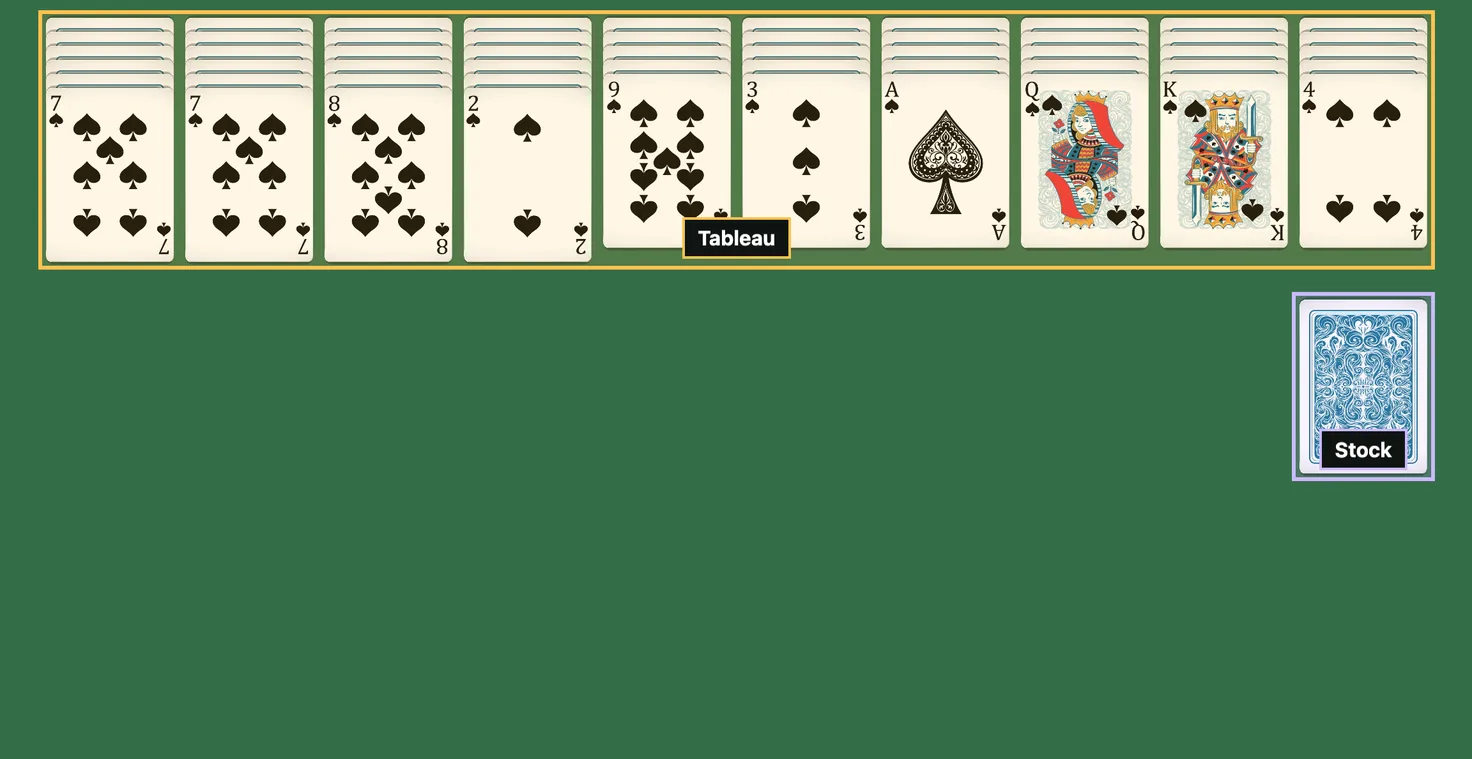
- Tableau: ten columns holding 54 cards. The first four columns get six cards each and the remaining six get five. Only the last card of each column is face-up; the rest are face-down underneath it.
- Stock: the 50 cards left over, sitting to the right below the columns. They come out ten at a time, one per column, which is five deals for the entire game.
How to win Spider Solitaire
Build eight complete runs from King down to Ace. Each finished run is taken off the table as soon as its last card lands — no fanfare, it simply disappears and leaves the column shorter. When the eighth one goes, the game is won.
Spider Solitaire rules
- Cards stack downward one rank at a time. A 9 takes an 8, an 8 takes a 7, and so on to the Ace. An Ace takes nothing.
- Cards already in order move together. A 10, 9, 8 sitting in sequence at the end of a column lift as one block. That is the gift of the single suit: at Spider 2 Suits and Spider 4 Suits a block moves only if the cards match suit as well.
- An empty column accepts anything. A lone card of any rank, or a run that is already in order. You are not restricted to Kings.
- Face-down cards turn themselves over the moment they end up last in their column. There is no separate flip to perform.
- Tap and the game chooses; drag and you choose. A tap picks up the card plus everything above it and sends it to the best legal home — or does nothing, if those cards are not already in order or have nowhere to go. Dragging picks up the same cards and lets you aim.
- A deal lands on all ten columns. Each column gets one new face-up card on top of what is there. You do not get to say which card goes where.
- You cannot deal while a column is empty. Tap the stock and nothing happens; fill the gap first.
- Thirteen cards in order, King to Ace, leave the table. It happens by itself, and any face-down card beneath them turns over.
Spider Solitaire tips and strategy
- Uncovering a face-down card beats almost anything else. Every card turned is another option. When two moves look equal, take the one that exposes something new.
- Start on the short columns. The six five-card columns empty before the six-card ones, and the space you open there pays for the rest of the game.
- At one suit, eight copies of every card exist. If the 8 you need is buried, seven more are somewhere in the deal. Scan all ten columns before you dismantle one.
- An empty column is a sorting bench. Move a jumbled column into it one card at a time and put the run back in the right order. Without that space, some columns simply stay stuck.
- Tidy the board before you touch the stock. Ten random cards land on top of your work. Make every useful move first, then deal — you only get five deals in the whole game.
- Decide what an empty column is for before you deal. While it sits empty the stock is frozen, so either fill it and deal, or keep it open and keep working the columns. Choosing in advance saves moves.
- Do not break a long run for one card. Six or seven cards in order are half a game's work. Taking them apart to expose a single face-down card is rarely worth it.
When this version stops resisting, Spider 2 Suits adds the one rule missing here: a block only moves if the cards share a suit. Spider 4 Suits puts all four suits on the table at once.