FreeCell Solitaire: play free online
FreeCell is the solitaire game with nothing hidden. All 52 cards lie face-up before you make a move — there is no stock to draw from, nothing to turn over, no card you have not already seen. What decides the game is the order you choose to move the cards in, not what comes next.
The name comes from the four free cells: four boxes at the top left that each hold exactly one card while you get it out of the way. They are the game's most valuable resource and its tightest constraint, because once all four are full the board seizes up and the number of legal moves collapses.
Against Klondike the difference is rhythm. There you turn a card and react; here you look at the whole table and decide. Learning how to play FreeCell takes about a minute. Learning to read a deal before you touch it takes a lot longer. Most deals can be solved, though the game promises nothing — when one jams, a fresh deal usually beats grinding away at it.
How to play FreeCell
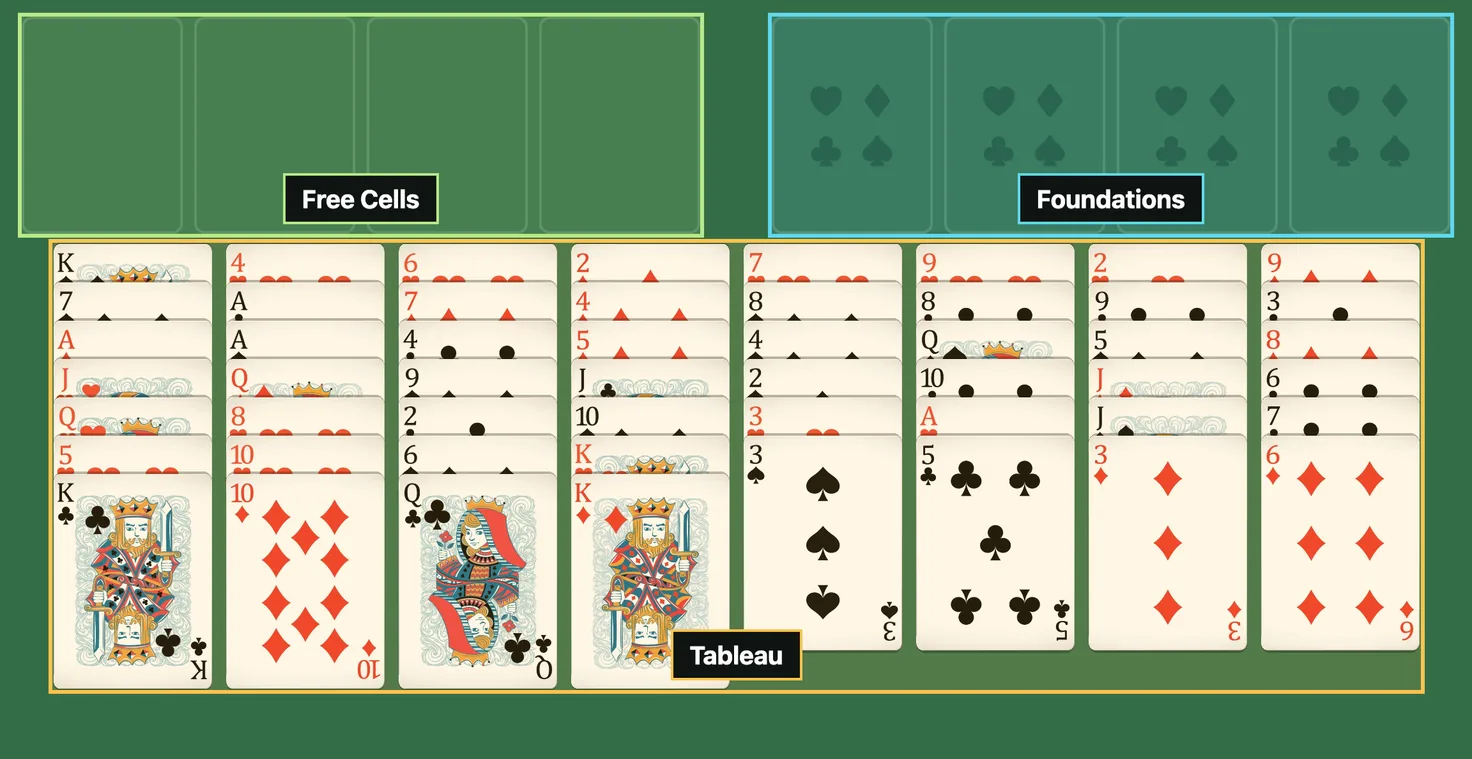
One 52-card deck, dealt out completely:
- Tableau: eight columns of face-up cards. The first four hold seven cards each, the last four hold six. Nothing is face-down and nothing is held back.
- Free cells: four empty boxes at the top left, one card apiece.
- Foundations: four empty piles at the top right. Every card has to end up there.
How to win at FreeCell
Build all four foundations up by suit, ace through king. Once every column runs in descending order of rank from its base — and whatever is still parked in a cell can go straight up — nothing blocks anything any more, and the game carries the rest home by itself. The last king lands and the deal is won.
FreeCell rules
- Tableau columns build down in alternating colors. A red 9 takes a black 8, and that black 8 takes a red 7. Color is what counts, not suit — the 7♣️ and the 7♠️ are interchangeable.
- A free cell holds one card, and only one. Any exposed card can go there, and it comes straight back out the moment it has somewhere to be. Until then the cell is spent.
- Any card can start an empty column. You do not need a king. An ace, a 7, a whole ordered run — all fine. That is why an empty column is worth more than an empty cell.
- Ordered runs move as a block when you have room for them. The app shifts the block for you, but only to the extent you could have carried the cards one at a time. With four empty cells you can move five cards, and every empty column doubles the figure: five becomes ten, then twenty. A column that is itself the destination does not count towards the doubling. Ask for more than your space allows and the move is refused.
- Foundations climb by suit from the ace. The A♥️ takes the 2♥️, never the 2♦️.
- A card on a foundation can come back down. If you sent the 4♠️ up early and now want it under a red 3, drag it back into the tableau.
FreeCell tips and strategy
- Find the aces and the 2s before your first move. They are almost never useful as landing spots. Count the cards stacked on top of each one — that number is a fair measure of how hard the deal will be.
- Treat the cells as a loan, not as storage. Every card you park has to re-enter play eventually. Before filling a cell, ask where that card is going to go next; if you have no answer, there is usually a better move on the board.
- Work towards emptying a whole column. It accepts any card, it can hold an entire run, and it doubles how many cards you can move at once. When a column gets short, finishing the job often beats anything else available.
- Do not rush cards onto the foundations. Sending a card up always feels like progress, but a low card left on the table is a landing spot for the cards above it. If the 3♦️ is holding a black 2 you still need, leave the 3 where it is.
- Watch the longest column. The cards that genuinely block you are the ones near its base. Convenient moves elsewhere keep the game ticking over, but until those cards come free the position has not really changed.
- Click a card rather than dragging it. The game sends it to the best legal destination it can find, and it will never park a card in a cell when a column or a foundation will take it. Drag only when you want one particular square.
- You can ask for an easier deal. Easy, Medium and Hard sit beside the random shuffle in the New Game menu, rated on how far down the aces and the 2s are sitting.
- Undo is a thinking tool. Go back a few moves, try the other line, compare the two. Exploring is part of the game rather than a way around it.
If the color rule starts to feel generous, Baker's Game lays out the same eight columns but builds by suit, and Eight Off adds that same suit rule to eight cells, with empty columns reserved for kings.