Baker's Game Solitaire: play free online
Baker's Game changes exactly one rule of FreeCell, and that one rule changes everything: tableau columns build down by suit. The 9♥️ takes the 8♥️ and nothing else — not the 8♠️, not the 8♣️.
It sounds like a detail. It halves your options on every single move. Where the alternating-color rule gives a card two cards it can land on, Baker's Game gives it one, and that one card can be anywhere: buried mid-column, or already gone up to a foundation. Boards lock up sooner and more often. Among the cell games, Baker's Game has a reputation as the hardest. People usually arrive here looking for "FreeCell same suit": the same eight columns, the same four cells, one rule changed.
It is not a stricter modern take on FreeCell — it is the older game. Martin Gardner described it in his "Mathematical Games" column in Scientific American in 1968 and credited it to C. L. Baker. Ten years later Paul Alfille relaxed this same rule to alternating colors for a computer version written on the PLATO system, and those are the rules nearly everybody plays today.
How to play Baker's Game
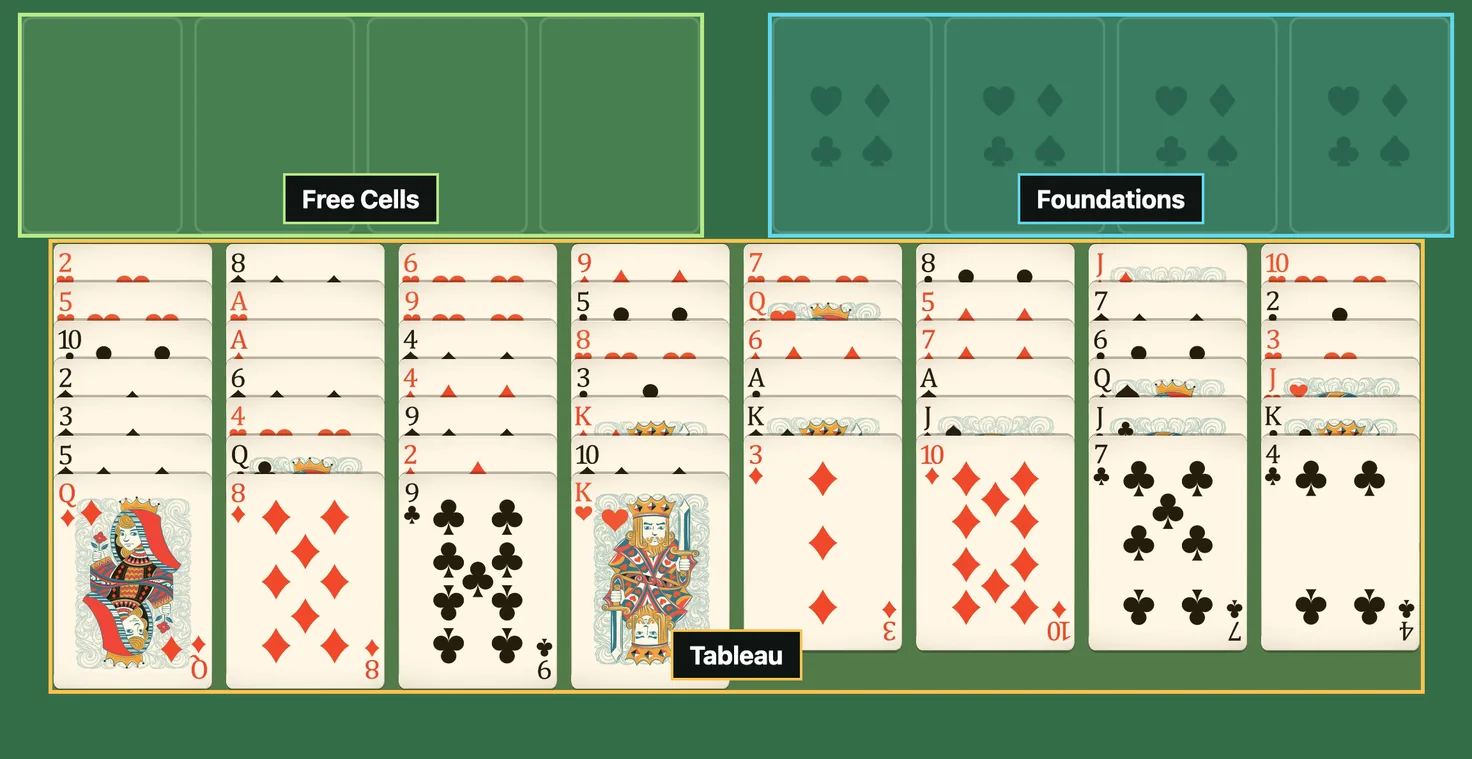
The board is dealt exactly as it is in FreeCell, card for card. Only the stacking rule differs:
- Tableau: eight columns of face-up cards, four of seven and four of six — all 52, none face-down.
- Free cells: four, empty at the start, one card each.
- Foundations: four empty piles with no suit assigned yet. Each takes the suit of whichever ace opens it.
How to win at Baker's Game
Fill the four foundations, one per suit, ace up to king. Once no card covers a lower-ranked card anywhere on the table — and every card sitting in a cell has a foundation ready to take it — the game sends the remainder up for you; on a won deal the columns and the cells are all empty.
Baker's Game rules
- Columns build down in the same suit. The 6♦️ accepts the 5♦️ and nothing else. This is the rule that separates Baker's Game from FreeCell, and it is easy to forget for the first few deals — the board simply refuses moves that break it.
- A free cell takes one card. You can pull it back out the moment it has a home, on a column or on its own foundation, but while it sits there one of your four cells is gone.
- Any card may enter an empty column. It is the one place on the table that ignores suit, and a lone low card is perfectly welcome there.
- An ordered run travels in one piece. How many cards at a time depends on your free space: four empty cells move five cards, and each empty column doubles the count — except the column the run is landing in, which does not count. The catch is that a run here must be all one suit, so you will find far fewer of them, and far shorter ones.
- Foundations build up by suit, ace to king. The same suit rule as the columns; the only difference is that here you build up instead of down.
- You can call a card back down from a foundation. Sent it up too early and now need it as a base? Pull it back down and use it.
Baker's Game tips and strategy
- Think in suit chains, not card by card. Each suit forms a sequence independent of the other three. Before moving, find where the 6 and the 5 of one suit are sitting — bringing those two together is worth more than three moves made at random.
- Hunt for same-suit cards stacked the wrong way round. If the 7♠️ lies on top of the 4♠️ in a column, that 7 has to move eventually, and its only destinations are an 8♠️, an empty column, or a cell. Spot those knots early: they decide the deal.
- Empty columns count for more here than they do under alternating colors. With so few natural landing spots, a column that accepts any card is often the only way out of a jam. Two or three moves spent opening one are usually moves well spent.
- Send low cards up without agonizing over it. Holding a 2 or a 3 back as a base makes good sense under alternating colors. It rarely does here, because the same-suit base you are keeping it for is scarce and seldom turns up in time.
- Recognize a dead deal early. Not every Baker's Game deal can be solved, and the table does not look any different when it cannot. Cells full and no column willing to move is the end of that deal — start another rather than pushing at it.
- Undo earns its keep. With a single landing spot per card, the order of your moves matters enormously, and trying an order out is the only way to learn whether it works.
If building by suit feels too severe, go back to FreeCell and its alternating colors. If you like the suit rule but want more room to maneuver, Eight Off keeps it and doubles the cells to eight.