Eight Off Solitaire: play free online
Eight Off gives generously and takes back just as much. It gives you eight cells instead of four, which over a whole deal is far more room to work in than FreeCell ever allows. In exchange it imposes two harder rules: columns build down by suit, and only a king may enter an empty column.
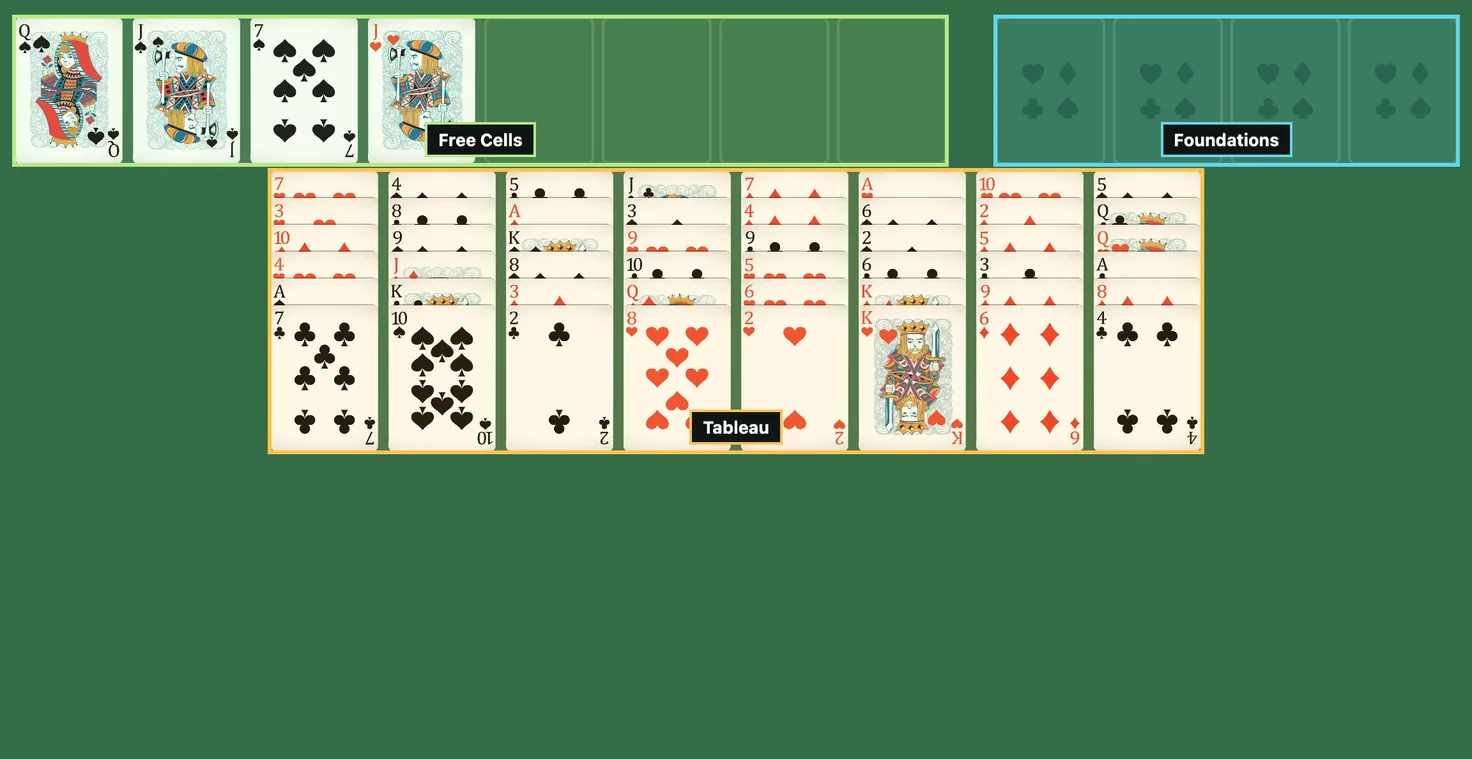
Then there is the thing you notice the moment the board appears — four of the eight cells already have cards in them. You begin with four cells free, exactly as many as FreeCell gives you, and the opening moves of almost every deal are spent clearing the other four.
Eight Off forgives a mistake more readily than Baker's Game does, but learning how to play Eight Off means holding one idea firmly in mind: with no king to put in it, an empty column is worth nothing at all.
How Eight Off is dealt
The 52 cards go out like this:
- Tableau: eight columns of six face-up cards each, 48 cards in all. Nothing is face-down.
- Cells: eight boxes along the top left. The last four cards of the deck drop into the first four cells; the remaining four cells start empty.
- Foundations: four empty piles, to be filled one suit at a time.
How to win at Eight Off
Empty the columns and the cells by moving all 52 cards onto the foundations, one suit per pile, ace up to king. Once nothing is blocking anything, the last cards go up on their own.
Eight Off rules
- Columns build down within one suit. The 10♠️ takes the 9♠️ and nothing else. Red and black are not the point here; it has to be the same suit.
- Only kings enter an empty column. This is the rule that defines Eight Off. An empty column will not take just any card — it sits there waiting for a king, or for a run headed by one.
- Eight cells, one card in each. Each behaves the way a FreeCell cell does: you set a card aside until you can find it a base, and in the meantime that cell is unavailable for anything else.
- How much of an ordered run you can move depends on your empty cells alone. Three empty cells move four cards; eight empty cells move nine. An empty column adds nothing to that total, because it could not hold the run's lower cards in passing — it accepts only kings.
- Foundations run ace to king, one suit per pile. Send the aces up as soon as they come free.
- A card can come back down from a foundation. If you need it as a base in the tableau after all, take it back.
Eight Off tips and strategy
- Your first job is emptying those four full cells. Until you have, you are playing with FreeCell's working space under stricter rules — the worst of both. Work out where those four cards can go before you move anything else.
- An empty column is useless without a king to put in it. This is the trap most players fall into. Clearing a column means finding a home for six cards, and with no king in hand it just sits there afterwards. Pick out an exposed king, or one you can uncover cheaply, and then go and make room for it.
- A buried king is a problem, not an asset. A king under five cards needs five bases or five cells before it comes free. Count that cost first: another king nearer the surface is often the better target.
- Keep two cells in reserve. With all eight full you cannot set anything aside at all. You are down to foundation moves and whatever direct column-to-column or cell-to-column moves the suit rule happens to permit, which are very few.
- Read the suits, not the tidy-looking runs. The board opens up when you bring consecutive cards of one suit together. A neat descending run in mixed suits is worth nothing here.
- Tap a card and let the game place it. A tap sends the card to the destination it rates highest — a foundation if one will take it, otherwise a column it builds on, and a cell only as a last resort. Drag instead when you want a particular square.
- Hint and Undo pay off more here than elsewhere. Legal moves are scarce and some are easy to miss. Hint offers you one; Undo takes you back as soon as you see that the line you picked leads nowhere.
The three cell games look alike and play nothing alike. If you want more freedom on the columns, take FreeCell; if you want the hardest of the three, try Baker's Game. For the same suit rule spread over two decks, with a stock to draw from and no cells at all, there is Forty Thieves.